Types of affiliate programs in iGaming: Choose best for 2026

Choosing the right affiliate program in iGaming can make or break your revenue potential. With multiple commission models available, from revenue share to CPA and hybrid structures, understanding which program aligns with your traffic quality and marketing goals is essential. This guide breaks down the main affiliate program types in iGaming and provides a clear framework to help you select the best option for maximizing your earnings and building sustainable partnerships in 2026.
Table of Contents
- How To Choose The Right Affiliate Program For IGaming Marketers
- Revenue Share Affiliate Programs
- CPA (Cost Per Acquisition) Affiliate Programs
- Hybrid Affiliate Programs
- Sub-Affiliate Programs
- Recurring Commission Programs
- Cost Per Lead (CPL) Affiliate Programs
- Summary Comparison And Situational Recommendations
- Boost Your IGaming Affiliate Success With Affiliate Roulette
- Frequently Asked Questions
Key takeaways
| Point | Details |
|---|---|
| Multiple program types available | Revenue share, CPA, hybrid, sub-affiliate, recurring, and CPL models each serve different affiliate strategies and traffic profiles. |
| Commission structures vary widely | Programs range from 25-45% revenue share to $50-$200 CPA, with payment timing and player retention impact differing significantly. |
| Match program to traffic quality | High-quality, engaged traffic suits revenue share while high-volume conversion traffic works better for CPA models. |
| Diversification reduces risk | Combining multiple program types creates stable income streams and balances upfront payments with long-term earnings. |
How to choose the right affiliate program for iGaming marketers
Selecting the right affiliate program starts with understanding your traffic profile and business objectives. Key criteria include commission structure, payment frequency, marketing support, player lifetime value, and conversion requirements, all of which directly impact your earnings potential and partnership sustainability.
Commission structure determines how you earn, whether through upfront payments, ongoing revenue percentages, or hybrid combinations. Payment frequency affects your cash flow, with some programs offering weekly payouts while others settle monthly or quarterly. Marketing support from operators can significantly boost your conversion rates through quality creatives, landing pages, and promotional materials.
Player lifetime value matters most for revenue share models where your earnings grow with player activity over time. Conversion quality requirements vary by program, with some operators preferring fewer high-value players over large volumes of low-deposit users. Understanding these dynamics helps you match programs to your specific traffic characteristics.
Before diving into affiliate marketing basics in iGaming, evaluate your current traffic sources and player demographics. Are you driving high-intent players ready to deposit, or building awareness with casual users? Your answer shapes which program type delivers the best returns.
Pro Tip: Prioritize programs with reliable, frequent payments to maintain healthy cash flow, especially when starting out or scaling operations.
The decision framework also requires assessing your risk tolerance and time horizon. Quick cash flow needs favor CPA programs, while building long-term passive income suits revenue share models. Testing multiple approaches through finding iGaming affiliate partners allows you to discover what works best for your unique situation.
Finally, consider operator reputation and tracking reliability. Transparent reporting, responsive support, and fair terms matter as much as commission rates. Researching affiliate network best practices helps identify trustworthy partners who honor agreements and provide accurate performance data.
Revenue share affiliate programs
Revenue share programs pay affiliates a percentage of net revenue generated from referred players over their lifetime. This model aligns affiliate and operator incentives around player retention and long-term value rather than just initial acquisition.

Commission rates typically range from 25% to 45% of net gaming revenue, calculated after deducting bonuses, chargebacks, and fees. Higher-tier affiliates with proven quality traffic often negotiate rates at the upper end of this range. The percentage remains consistent as long as referred players stay active, creating potential for substantial passive income.
Key advantages include unlimited earning potential from high-value players and no cap on monthly commissions. A single whale player who bets heavily can generate thousands in monthly revenue share payments. This makes the model attractive for affiliates with established audiences and strong player retention strategies.
However, revenue share programs carry inherent risks. Earnings fluctuate based on player wins and losses, creating unpredictable monthly income. You also depend entirely on operator reporting accuracy, with no way to independently verify calculations. Payment cycles tend to run longer, often 30-60 days after the month ends.
Best suited for affiliates who:
- Drive high-quality, engaged players likely to remain active long-term
- Can withstand income variability month to month
- Have established traffic sources with proven conversion and retention metrics
- Prefer building passive recurring income over quick payouts
- Trust operator transparency and reporting systems
Many successful affiliates combine revenue share with other models to balance stability and upside potential. The igaming affiliate directory overview showcases operators offering competitive revenue share terms and transparent reporting.
CPA (cost per acquisition) affiliate programs
CPA programs pay a fixed commission for each new depositing player you refer, regardless of their subsequent activity or losses. This acquisition-focused model provides predictable, upfront payments that simplify financial planning and cash flow management.
Typical CPA rates in iGaming range from $50 to $200 per qualified player, with premium rates for specific GEOs or high-value player segments. Payment occurs once the player meets qualifying conditions, usually making a minimum first deposit between $20 and $50. Some programs require additional activity thresholds before triggering payment.
The primary advantage is payment predictability and speed. You know exactly what each conversion earns, making it easier to calculate ROI on marketing spend and scale profitable campaigns. Most CPA programs pay within 15-30 days, significantly faster than revenue share models.
CPA programs suit high-volume affiliates who excel at driving conversions but may not retain players long-term. If your traffic converts well initially but shows lower lifetime engagement, CPA captures value upfront before player churn occurs. This model also reduces exposure to player winning streaks that can temporarily reduce revenue share earnings.
Drawbacks include capped earning potential per player and missing out on long-term value from high-rollers. A player who deposits $100 initially but goes on to wager $50,000 over six months generates the same $150 CPA as one who deposits once and never returns. You also face stricter fraud monitoring, as operators guard against inflated or low-quality sign-ups.
Ideal for affiliates who:
- Generate high traffic volumes with strong conversion rates
- Need consistent cash flow for operational expenses or reinvestment
- Focus on paid acquisition channels requiring quick ROI validation
- Lack long-term player retention data or engagement mechanisms
- Prefer simplicity in tracking and payment calculation
Navigating common challenges for new iGaming affiliates becomes easier with CPA programs that provide immediate feedback on campaign effectiveness.
Hybrid affiliate programs
Hybrid programs combine CPA and revenue share elements, offering both upfront acquisition payments and ongoing percentage commissions. This dual structure balances immediate cash flow with long-term earning potential, making it increasingly popular among affiliates and operators.
Hybrid models typically pair fixed CPA with ongoing revenue share, improving retention and balancing risk for both parties. A common structure might offer $100 CPA plus 20% revenue share, or $50 CPA with 30% revenue share. The trade-off between upfront and ongoing rates varies by program and negotiation.
The appeal lies in mitigating each model’s downsides. CPA provides working capital while you build revenue share income, and revenue share captures long-term player value CPA models miss. This creates win-win scenarios where affiliates maintain cash flow while operators incentivize quality player acquisition.
Hybrid programs prove especially valuable during growth phases when affiliates need capital to scale marketing efforts while building passive income streams. The CPA portion funds new campaigns while revenue share compounds over time as your player base expands.
Customization options make hybrid programs flexible. Some operators let affiliates choose their CPA/revenue share ratio based on traffic quality and business priorities. Others adjust terms quarterly based on player performance metrics, rewarding affiliates whose players show strong retention.
“Hybrid models represent the future of affiliate partnerships in iGaming, aligning incentives while providing the financial flexibility affiliates need to grow sustainably.”
Benefits include:
- Immediate working capital from CPA payments to fund operations
- Long-term income growth through revenue share on retained players
- Reduced risk exposure compared to pure revenue share or CPA models
- Operator commitment to supporting affiliate success through balanced incentives
- Flexibility to adjust ratios based on performance and goals
Exploring iGaming network partnerships reveals numerous operators embracing hybrid structures as their preferred affiliate compensation model.
Sub-affiliate programs
Sub-affiliate programs create a secondary revenue stream by paying commissions on earnings generated by other affiliates you recruit. This network marketing approach rewards affiliates for building and managing teams rather than solely focusing on direct player acquisition.
Commission structures typically pay 5% to 10% of sub-affiliate earnings, creating leveraged income that scales with team performance. If you recruit an affiliate earning $10,000 monthly in commissions, a 10% sub-affiliate rate generates an additional $1,000 for you without direct player referrals.
The scalability advantage is significant for super-affiliates and marketing agencies. Instead of being limited by personal traffic generation capacity, you can multiply earnings through team recruitment and support. This model rewards leadership, training, and relationship building alongside marketing skills.
However, sub-affiliate programs introduce tracking and management complexity. You need systems to monitor team performance, provide support and training, and ensure compliance across multiple affiliates. Payment delays can extend as calculations require processing sub-affiliate earnings before determining your commission.
Legitimate sub-affiliate programs differ from pyramid schemes by maintaining focus on actual player acquisition and revenue generation. Your sub-affiliate commissions supplement rather than replace earnings from direct referrals, and compensation derives from real gambling activity, not just recruitment.
Best for affiliates who:
- Have established networks or communities to recruit from
- Possess training and mentorship capabilities to support team success
- Can manage multiple relationships and track complex commission structures
- Want to build scalable business models beyond personal capacity limits
- Already succeed with direct player acquisition and want additional leverage
Researching top iGaming affiliate networks helps identify programs with robust sub-affiliate tracking and fair compensation terms.
Recurring commission programs
Recurring commission programs pay ongoing percentages based on continuous player activity, particularly deposits and subscription fees. This model focuses on sustained engagement rather than one-time acquisitions or total revenue share calculations.
Commission rates typically range from 10% to 20% of recurring deposits or subscription fees, lower than traditional revenue share but more stable. Payments continue as long as referred players remain active, creating predictable monthly income streams similar to SaaS recurring revenue.
This structure aligns perfectly with subscription-based casino models and VIP programs where players make regular deposits. Each monthly deposit triggers a commission payment, rewarding affiliates for driving loyal, habitual players rather than sporadic users.
The growing trend toward VIP and subscription models in iGaming makes recurring commissions increasingly relevant. Operators value affiliates who can attract committed players willing to maintain ongoing relationships rather than chasing bonuses across multiple sites.
Stability represents the key advantage. Unlike traditional revenue share that fluctuates with player wins and losses, recurring commissions depend on deposit frequency and amount. This creates more predictable income forecasting and smoother cash flow management.
Ideal scenarios include:
- Targeting high-value player segments with regular gaming habits
- Promoting subscription-based or VIP casino programs
- Building content that encourages habitual play and loyalty
- Focusing on player lifetime value over quick conversions
- Creating communities that reinforce ongoing engagement
Exploring niche opportunities in iGaming reveals VIP-focused programs where recurring commission models thrive.
Cost per lead (CPL) affiliate programs
CPL programs compensate affiliates for generating qualified leads, typically player registrations, regardless of whether deposits occur. This top-of-funnel approach values awareness and sign-ups over immediate monetary transactions.
Payment rates usually range from $5 to $20 per qualified lead, significantly lower than CPA or revenue share models. Qualification criteria vary but generally require valid registration information and email verification. Some programs add activity requirements like account verification or initial site interaction.
The lower earning potential reflects reduced value to operators since many leads never convert to depositing players. However, CPL programs suit specific traffic types and marketing approaches where deposit-focused models underperform.
Best applications include content marketing to casual audiences, brand awareness campaigns, and early-stage funnel building. If your traffic consists of browsers and researchers rather than ready-to-deposit players, CPL captures value from interactions that other models ignore.
CPL programs also work for affiliates testing new traffic sources or GEOs where conversion rates remain uncertain. The lower barrier to earning allows validation of audience quality before committing to performance-intensive CPA or revenue share agreements.
Drawbacks include:
- Substantially lower per-action earnings than other models
- No participation in player lifetime value or deposit revenue
- Higher volume requirements to generate meaningful income
- Operator scrutiny on lead quality to prevent gaming the system
- Limited long-term growth potential compared to deposit-based models
Ideal for affiliates who:
- Generate large volumes of non-depositing or early-stage traffic
- Focus on awareness and list-building over immediate conversions
- Test new marketing channels with unproven conversion rates
- Operate in highly regulated markets with deposit restrictions
- Build email lists or communities for long-term nurturing
Reviewing the affiliate directory overview helps identify operators offering competitive CPL terms alongside other commission models.
Summary comparison and situational recommendations
Understanding when each program type works best requires comparing structures, trade-offs, and ideal use cases side by side.
| Program Type | Commission Range | Payment Timing | Best For | Primary Risk |
|---|---|---|---|---|
| Revenue Share | 25-45% of net revenue | 30-60 days | Quality traffic, long-term focus | Income volatility, operator dependency |
| CPA | $50-$200 per player | 15-30 days | High-volume conversions, quick ROI | Capped earnings, missing long-term value |
| Hybrid | $50-$100 CPA + 20-30% revenue share | 15-60 days | Balanced approach, growth phase | Complexity in optimization |
| Sub-Affiliate | 5-10% of sub-affiliate earnings | 45-90 days | Network building, scalability | Management overhead, delayed payments |
| Recurring | 10-20% of deposits | 30-45 days | VIP focus, subscription models | Limited operator availability |
| CPL | $5-$20 per lead | 15-30 days | Early-stage traffic, testing | Low per-action value |
Situational recommendations guide your program selection:
- Choose revenue share when driving high-quality players to trusted operators with transparent reporting
- Select CPA for quick cash flow needs, paid traffic campaigns requiring fast ROI validation, or uncertain player retention
- Opt for hybrid programs during growth phases when balancing working capital needs with long-term income building
- Pursue sub-affiliate models after establishing direct success and building networks to recruit and support
- Target recurring commissions when focusing on VIP players or subscription-based casino products
- Use CPL for testing new traffic sources, building email lists, or operating in deposit-restricted markets
Portfolio diversification reduces risk and smooths income variability. Combining CPA for stable base income with revenue share for upside potential creates balanced earnings. Adding hybrid programs provides middle-ground options while sub-affiliate income builds through team growth.
Pro Tip: Evaluate your traffic quality and player retention data before committing exclusively to any single program type, and negotiate terms based on proven performance metrics.
The trade-off between immediate and long-term earnings shapes most decisions. CPA and CPL provide quick returns but sacrifice future value, while revenue share and recurring models require patience but compound over time. Hybrid programs split the difference, making them excellent starting points.
Applying insights from common issues for iGaming affiliates helps avoid pitfalls when selecting and optimizing program types.
Boost your iGaming affiliate success with Affiliate Roulette
Now that you understand the main affiliate program types in iGaming, finding the right partners becomes your next priority. Affiliate Roulette connects you with verified operators offering competitive commission structures across all program types discussed here.
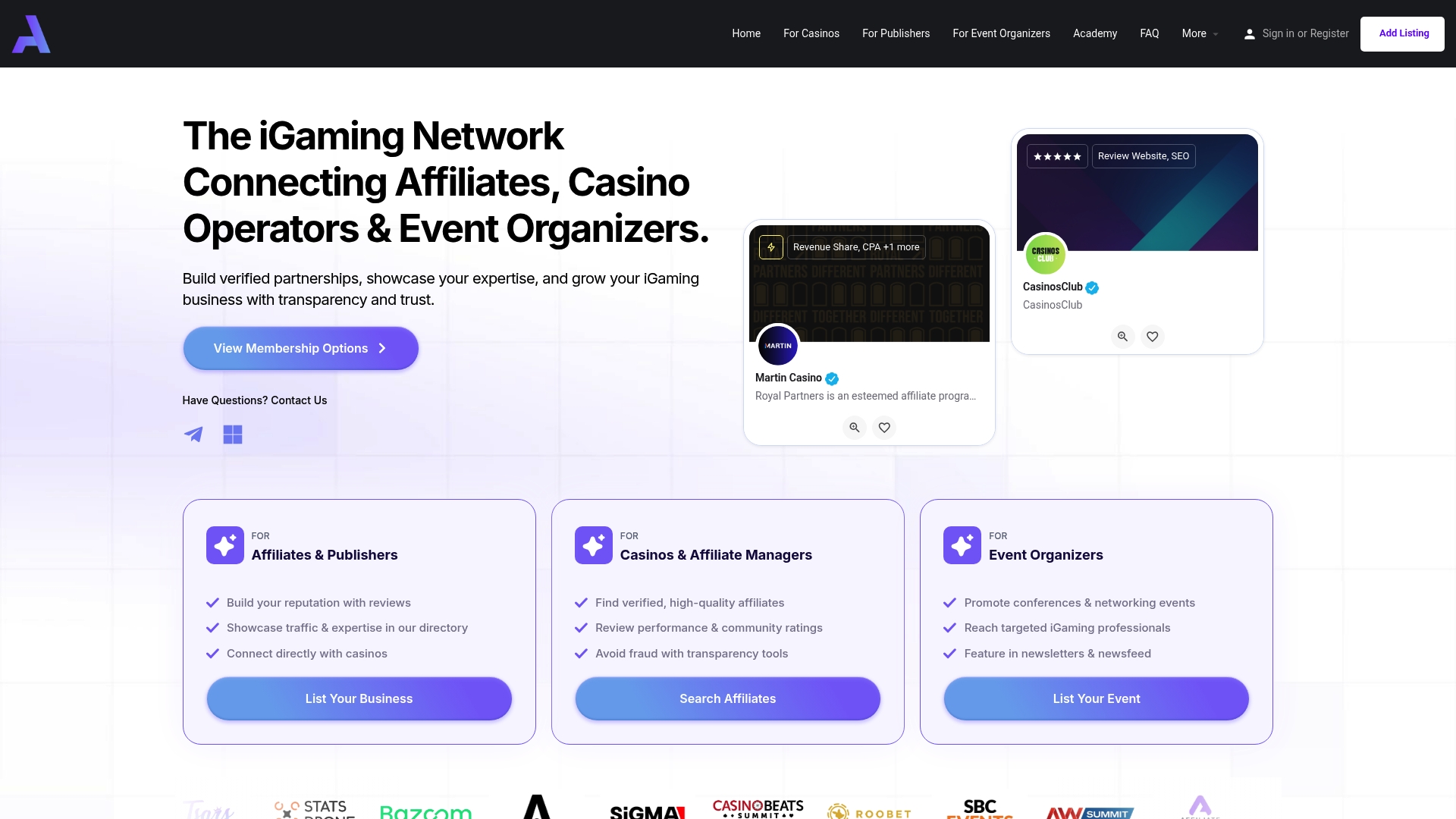
Our platform provides detailed program comparisons, operator reviews, and community ratings to help you identify trustworthy partners aligned with your traffic and goals. Whether you’re seeking strategies for maximizing ROI, resources for finding quality partners, or insights on emerging regulatory trends, Affiliate Roulette delivers the tools and intelligence you need to succeed in 2026 and beyond.
Frequently asked questions
What is the main difference between revenue share and CPA affiliate programs?
Revenue share pays a percentage of player losses over their lifetime, creating ongoing passive income that depends on player retention. CPA pays a fixed amount per new depositing player, providing upfront predictable payouts regardless of subsequent activity. Revenue share offers unlimited earning potential from high-value players while CPA delivers faster, more stable cash flow.
Which affiliate program type is best for beginners in iGaming?
Beginners often start with CPA programs for predictable upfront payments and simpler tracking that provides clear ROI feedback. The fixed commission structure makes financial planning easier and reduces exposure to income volatility. Balancing CPA with revenue share or hybrid models can grow long-term earnings as you gain experience and understand your traffic quality.
Can I participate in multiple affiliate program types simultaneously?
Yes, combining CPA, revenue share, and hybrid programs diversifies income and reduces risk from any single commission model. Portfolio diversification smooths cash flow variability and captures value from different player segments. Select program types that align with your traffic quality and marketing strategies, testing performance across models to optimize your mix.
How important is player retention in choosing an iGaming affiliate program?
Player retention directly impacts revenue share and recurring commission earnings, making it critical for these models. Programs focusing on long-term player value require you to target quality, engaged audiences rather than high-volume, low-retention traffic. If your traffic shows strong retention metrics, revenue share models maximize earnings, while poor retention favors upfront CPA payments.
Recommended
Comments
You must be logged in to leave a review.