What Is Affiliate Marketing – Building Trust in iGaming

Every affiliate marketer in iGaming quickly learns this space is anything but simple. With the online gambling sector generating over $100 billion annually, the stakes and challenges are on another level compared to most industries. Understanding the complex ecosystem of operators, compliance demands, and advanced tracking tools is crucial for building sustainable strategies and trustworthy partnerships. This guide helps you navigate what makes iGaming affiliate marketing truly unique so you can maximize results while protecting your reputation.
Table of Contents
- Defining Affiliate Marketing in iGaming
- Types of Affiliate Partnerships Explained
- How Affiliate Tracking and Payments Work
- Essential Safety and Fraud Prevention Steps
- Legal and Compliance Demands for Affiliates
Key Takeaways
| Point | Details |
|---|---|
| Affiliate Marketing Model | iGaming affiliate marketing is a performance-based system where publishers earn commissions for driving players to operators, requiring a sophisticated understanding of player behavior and regulations. |
| Commission Structures | Affiliates thrive on performance-based models, primarily revenue share, which emphasizes long-term player retention and quality over mere signup volume. |
| Partnership Types | Diverse affiliate partnership models exist, such as SEO affiliates and media buyers, each requiring specific skill sets to optimize revenue potential. |
| Compliance and Regulations | Affiliates must navigate complex legal landscapes that vary by jurisdiction, ensuring adherence to regulations to protect partnerships and sustain earnings. |
Defining Affiliate Marketing in iGaming
Affiliate marketing in iGaming is a performance-based partnership model where publishers earn commissions by driving qualified traffic and players to casino operators. Unlike traditional affiliate programs, the iGaming space operates within a complex ecosystem of operators, affiliates, and tracking infrastructure working toward mutual growth.
At its core, the relationship is simple: you promote a casino, attract players, and earn money for results. But the execution demands far more sophistication than other industries.
How It Actually Works
iGaming affiliates connect operators with potential customers through multiple channels:
- Display advertising on your website or blog
- Content marketing and guides about casino games or betting strategies
- Social media promotion and community engagement
- Email campaigns to existing audiences
- Paid search campaigns targeting specific keywords
- Influencer partnerships and streaming collaborations
Each method drives traffic back to the operator through your unique affiliate link, which tracks your referrals and attributes commissions accurately.
Commission Models That Matter
You don’t earn a flat fee for every signup. The iGaming affiliate marketing landscape uses performance-based models that reward actual business results:
- Revenue Share: You earn a percentage (typically 20–40%) of the net revenue players generate over time
- CPA (Cost Per Acquisition): A fixed amount for each qualified player signup
- Hybrid Models: Combining CPA payouts with revenue share tiers
Revenue share dominates because operators prefer affiliates who care about player retention and quality, not just signup volume.
Why iGaming Differs From Other Verticals
The online gambling industry operates differently from typical affiliate niches. Player lifetime value—how much money a player will spend over months or years—matters enormously. A single signup might seem worthless initially, but that player could generate thousands in revenue.
This means operators invest heavily in affiliate infrastructure to track player behavior accurately. Real-time dashboards show impressions, clicks, signups, and revenue attribution. Compliance requirements also exceed most industries due to gambling regulations across different jurisdictions.
Success in iGaming affiliate marketing requires understanding player behavior, geographic regulations, and long-term profitability—not just driving traffic volume.
The $100 Billion Opportunity
The online gambling sector generates over $100 billion annually. Affiliates capture a meaningful share by specializing in audience building and player acquisition. Platforms like Affiliate Roulette connect verified operators with serious publishers, making it easier to find legitimate partnerships in iGaming affiliate marketing that align with your audience.

Your success depends on matching your traffic sources with operators that serve your audience’s interests and geographic location.
Pro tip: Focus on building sustainable audiences rather than chasing quick commissions—players who trust your recommendations generate higher lifetime value and better long-term earnings for you.
Types of Affiliate Partnerships Explained
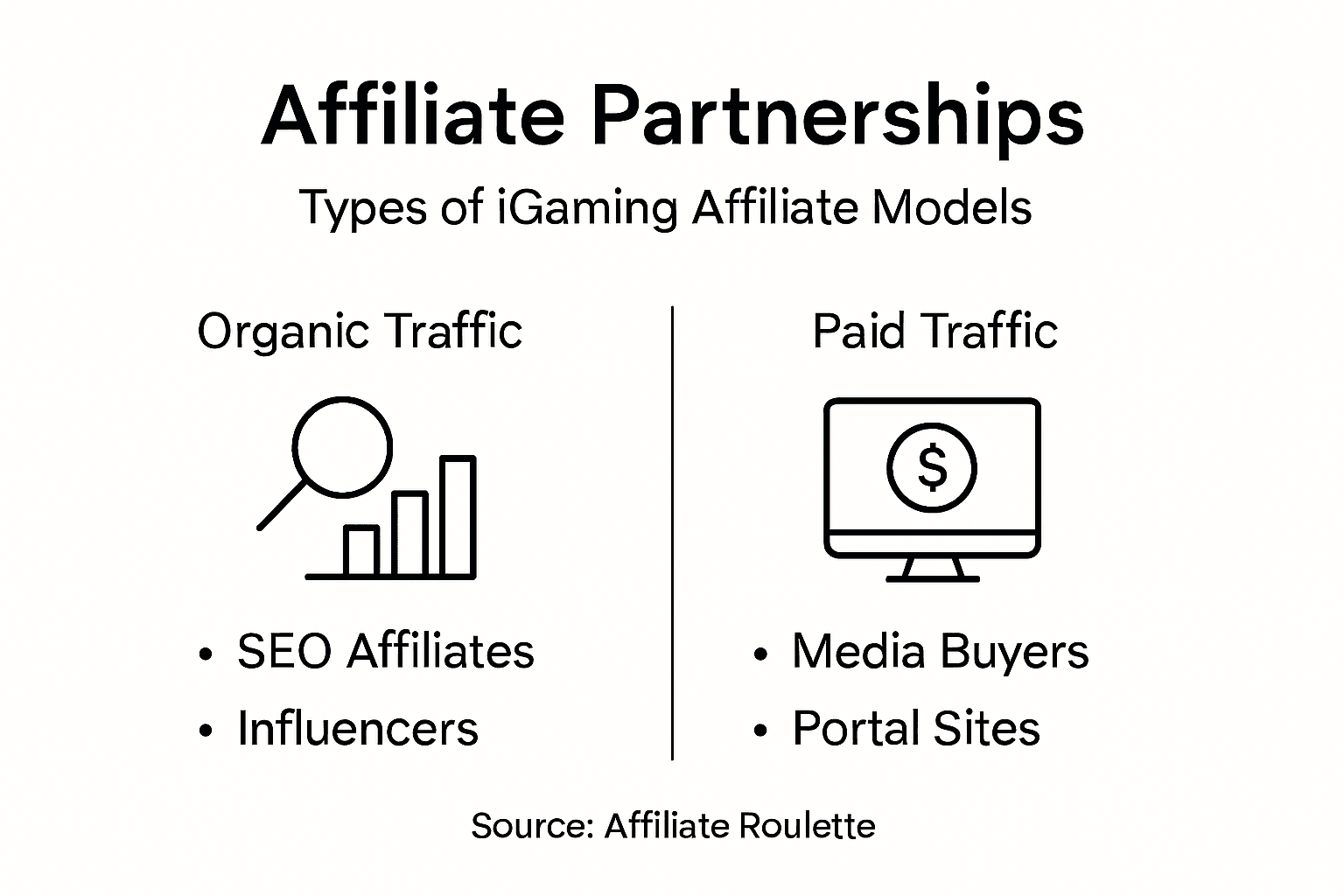
Affiliate partnerships in iGaming aren’t one-size-fits-all. Different operator needs and affiliate strengths create distinct partnership models, each with unique advantages and earning potential.
Understanding which partnership type matches your strengths helps you negotiate better terms and build sustainable revenue. The right fit means higher commissions and longer-term relationships.
SEO Affiliates: Organic Content Leaders
SEO affiliates build content authority through blogs, guides, and informational websites targeting players searching for casino information. They invest in long-form content optimized for search engines.
This partnership type works best if you:
- Create detailed casino reviews and comparison guides
- Attract consistent organic search traffic
- Build backlinks and domain authority
- Target evergreen keywords with high player intent
Operators value SEO affiliates because organic traffic typically converts at higher rates than paid traffic. You’re capturing players actively researching casinos.
Media Buyers: Performance-Driven Traffic
Media buyers purchase advertising space on social platforms, search engines, and display networks to drive players to operators. They focus on ROI and cost-per-acquisition optimization.
Media buying requires:
- Upfront advertising budget investment
- Real-time campaign optimization skills
- Testing and scaling successful ad creatives
- Proficiency with platforms like Google Ads or Meta
This model rewards data-driven professionals who understand audience segmentation and bidding strategies. Success depends on achieving lower customer acquisition costs than the operator’s commission offers.
Influencer Partnerships: Community Trust
Influencers—streamers, content creators, and social media personalities—leverage their audience relationship and credibility to recommend casino operators. Their followers trust their opinions.
Inflencer deals typically include:
- Fixed appearance fees or bonus commission tiers
- Sponsored streams or content placements
- Exclusive promotional codes for followers
- Long-term ambassador contracts
Operators increasingly seek evolving affiliate partnerships that provide brand equity and strategic value beyond traffic volume. Influencers deliver that.
Hybrid & Emerging Models
Modern partnerships blend multiple commission structures:
- Hybrid commissions: CPA payouts plus revenue share bonuses when players hit retention targets
- Performance-based bonuses: Extra payouts for quality metrics like player lifetime value or retention rates
- Retention-focused deals: Higher commissions for affiliate programs driving players who stay and spend
These models align affiliate incentives with operator profitability rather than just signup volume.
Modern operators value affiliates as strategic partners contributing to compliance, brand reputation, and sustainable growth—not just traffic pipelines.
Portal & Affiliate Network Sites
Affiliates managing comparison portals or casino listing directories aggregate multiple operator links. Traffic quality and volume drive value. iGaming affiliate programs increasingly incorporate advanced performance tracking and personalized commission structures.
These partnerships work when you maintain high-traffic, legitimate directories with strong search visibility.
Here’s a concise comparison of iGaming affiliate partnership types and their ideal skill sets:
| Partnership Type | Core Focus | Ideal Skill Set | Earning Potential |
|---|---|---|---|
| SEO Affiliate | Organic content | Content writing, SEO | High, long-term |
| Media Buyer | Paid campaigns | Ad management, analytics | Variable, scalable |
| Influencer | Audience trust | Social engagement, branding | Strong for top creators |
| Portal Directory | Aggregation/listings | Website management, traffic | Volume-driven |
Pro tip: Match your partnership type to your existing strengths—don’t force a media buying model if you’re a natural content creator, or vice versa. Your authentic skill set drives better results and sustainable earnings.
How Affiliate Tracking and Payments Work
Affiliate tracking is the backbone of iGaming partnerships. Without accurate tracking, neither you nor operators can verify player referrals, commissions, or attribution. It’s the technology that builds trust between both parties.
Understanding how tracking works helps you troubleshoot issues, optimize campaigns, and protect your earnings.
Affiliate Links: Your Traffic Fingerprint
Every affiliate receives a unique tracking link—a customized URL containing a special code that identifies you. When a player clicks your link and registers at the operator’s site, that code captures the referral.
Your tracking link might look like:
"https://casinoname.com/?ref=youraffiliateID`
Or through a platform like:
https://affiliatenetwork.com/click/youraffiliateID
The link persists through cookies, typically lasting 30-90 days. If the player returns and signs up within that window, you receive credit.
Real-time Tracking Dashboards
Operators and affiliate networks provide dashboards showing live performance metrics. You can monitor:
- Clicks and impressions from your traffic
- Signups and new player registrations
- Deposits and first-purchase conversions
- Revenue generated by your players
- Current earnings and pending payouts
Real-time tracking visibility allows you to identify underperforming campaigns immediately and optimize targeting or creative messaging.
How Payment Processing Works
Commissions accumulate in your account throughout the month. Operators calculate payouts based on your selected commission model:
Revenue Share Model:
- Operator tracks all wagers by your players
- Calculates net gaming revenue (deposits minus withdrawals and winnings)
- Multiplies by your agreed percentage (20-40%)
- Deposits commission to your account
CPA Model:
- Operator confirms qualified signup (email verified, account activated)
- Fixed amount (typically $20-$100) credited immediately
- Bonus multipliers apply if signup meets quality standards
Payment Frequency and Methods
Most operators process payouts monthly, though some offer weekly options. Payment methods vary:
- Wire transfers to your bank account
- Cryptocurrency transfers (Bitcoin, Ethereum)
- E-wallets (Skrill, Neteller, PayPal)
- Check payments (slower, less common)
Minimum payout thresholds typically range from $100-$500. Earnings below that threshold roll over to the next period.
Accurate tracking requires clean affiliate links, compliant traffic sources, and transparent operator infrastructure—the foundation of trustworthy partnerships.
Verification and Fraud Prevention
Operators monitor for fraud indicators to protect themselves and legitimate affiliates. Red flags include:
- Bot traffic and fake clicks
- Incentivized signups with real money offers
- Traffic from restricted jurisdictions
- Multiple accounts from the same player
Legitimate affiliates benefit from fraud prevention because it eliminates unfair competition and ensures accurate commission calculations.
Pro tip: Request detailed click-to-conversion reports monthly and cross-reference your traffic sources with tracked conversions—this identifies tracking discrepancies early and protects your earnings from attribution errors.
Essential Safety and Fraud Prevention Steps
Fraud threatens every affiliate partnership. Bad actors use fake traffic, stolen credentials, and cookie manipulation to steal commissions while damaging operator trust. Protecting yourself means understanding threats and implementing safeguards.
Legitimate affiliates benefit when fraud disappears—your earnings reflect real performance, and operators value your integrity.
Common iGaming Affiliate Fraud Schemes
Know the tactics fraudsters use so you can avoid them. Cookie stuffing involves injecting affiliate cookies into users’ browsers without consent, crediting fake referrals. Brand hijacking targets competitor branded search terms illegally.
iGaming affiliate fraud includes:
- Domain hijacking and subdomain spoofing
- Fake traffic from bots or compromised devices
- Incentivized signups violating affiliate agreements
- Multiple account creation by single players
- Bonus abuse targeting operator promotions
Understanding these schemes helps you recognize when your traffic sources cross ethical lines.
Below is a summary of common iGaming affiliate fraud indicators and recommended prevention strategies:
| Fraud Indicator | Impact on Business | Prevention Strategy |
|---|---|---|
| Bot traffic | Skews metrics, losses | Use traffic filters |
| Incentivized signups | Low quality conversions | Verify sources |
| Domain hijacking | Loss of commissions | Monitor domains |
| Geographic anomalies | Regulatory risks | Geo-target controls |
Verify Your Traffic Sources
Your reputation depends on traffic quality. Before running campaigns or buying traffic, ask yourself: Where does this traffic originate? Are users real people with genuine interest?
Legitimate sources include:
- Organic search engine traffic
- Direct website visitors (bookmarks, word-of-mouth)
- Legitimate display advertising networks
- Email subscribers who opted in
- Social media followers who follow organically
Avoid traffic marketplaces offering suspiciously cheap clicks—those typically involve bot networks or incentivized clicks.
Use Fraud Detection Tools
Operators provide dashboards showing conversion metrics. Monitor your own data for red flags like click-to-signup ratios that seem impossibly high or players who never deposit money.
Real-time monitoring helps you:
- Identify underperforming traffic sources immediately
- Spot unusual click patterns indicating bot activity
- Detect cookie-stuffing tactics inflating your metrics
- Catch geographic anomalies (clicks from countries you didn’t target)
When metrics look wrong, investigate before claiming commissions you didn’t legitimately earn.
Maintain Compliant Marketing Practices
Never use deceptive practices to drive signups. Avoid false advertising about game odds or payouts. Don’t offer real money incentives for registrations—operators explicitly prohibit this.
Black hat approaches damage your account and the entire ecosystem. Operators investigate suspicious activity and terminate partnerships immediately.
Compliance protects your long-term earnings because legitimate players generate higher lifetime value than fraudulent signups.
Transparent Operator Partnerships
Work only with operators using transparent tracking infrastructure and clear fraud policies. Reputable platforms provide detailed documentation about what constitutes fraudulent activity.
Fraud prevention is a shared responsibility—operators and affiliates must collaborate to maintain ecosystem integrity and trustworthy partnerships.
Ask potential partners about their fraud detection methods, cookie duration policies, and how they handle disputes. Legitimate operators welcome these conversations.
Pro tip: Document everything—keep records of your traffic sources, campaign dates, creative materials used, and monthly performance reports. If a dispute arises about fraud accusations, detailed documentation proves your legitimacy and protects your earned commissions.
Legal and Compliance Demands for Affiliates
Compliance isn’t optional in iGaming. Each jurisdiction where your traffic originates has specific legal requirements governing advertising, licensing, player protection, and data privacy. Ignoring these rules costs you partnerships, fines, and reputation damage.
Understanding your obligations protects your business and builds trust with operators who need compliant partners.
The Global Regulatory Patchwork
iGaming operates across dozens of countries, each with distinct laws. What’s legal in Malta might be prohibited in Germany. What works in the United States differs from United Kingdom rules.
iGaming affiliates face jurisdiction-specific compliance requirements covering:
- Advertising standards and creative restrictions
- Licensing and registration mandates
- Player protection and responsible gambling messaging
- Data privacy regulations like GDPR
- Anti-money laundering controls
- Affiliate disclosure and transparency rules
Your first step: identify which jurisdictions your traffic targets and research their specific requirements.
European Union and GDPR Compliance
The European Union’s General Data Protection Regulation is the gold standard for data privacy globally. GDPR applies whenever you collect, process, or store data about European Union residents—even if your business isn’t based in Europe.
Key GDPR obligations include:
- Obtaining explicit consent before collecting personal data
- Providing clear privacy policies explaining data use
- Allowing users to access, modify, or delete their data
- Reporting data breaches within 72 hours
- Appointing a data protection officer if handling large-scale data
Violations result in fines up to 4% of annual revenue. Operators terminate partnerships with non-compliant affiliates immediately.
Advertising Standards and Restrictions
Different regions restrict how you can promote casinos. The United Kingdom requires prominent responsible gambling messaging. Germany prohibits certain advertising channels entirely. Malta enforces strict rules about bonus promotions.
Never claim:
- Guaranteed winnings or inflated odds
- Quick riches through gambling
- That gambling cures financial problems
- Age-verification workarounds
Always include responsible gambling resources like helpline numbers and self-exclusion information. Operators require this before approving your marketing materials.
Transparent Affiliate Disclosure
You must clearly disclose your affiliate relationship to audiences. Readers need to know you earn commissions when they sign up through your links. Hidden relationships violate FTC guidelines and damage trust.
Proper disclosures:
- Appear near your affiliate links, not buried in fine print
- Use clear language: “I earn commissions from [Operator Name]”
- Apply to all promotional content including social media posts
- Stay consistent across all marketing channels
Operators partner with compliant affiliates because they reduce regulatory risk and demonstrate commitment to player protection and ethical marketing.
Documentation and Audit Trails
Keep detailed records of your advertising creatives, promotional campaigns, and compliance decisions. Operators audit affiliates and regulators investigate complaints. Documentation proves you operated within legal bounds.
Maintain records showing:
- Approval dates for marketing materials
- Geographic targeting parameters
- Responsible gambling disclosures used
- Data handling practices
- Consent collection methods
Pro tip: Consult a legal professional familiar with iGaming regulations in your target markets before launching campaigns—the cost of legal review is tiny compared to compliance fines, partnership terminations, or reputational damage from violations.
Build Trust and Boost Your iGaming Affiliate Success Today
Affiliate marketing in iGaming demands more than just traffic volume. It requires transparent, trustworthy partnerships that value player quality, compliance, and accurate performance tracking. If navigating complex commission models, regulatory challenges, and fraud prevention feels overwhelming, you are not alone. Affiliates and operators alike need a reliable platform to connect, verify, and grow together with confidence.
Affiliate Roulette specializes in bridging these gaps by offering a dedicated hub where verified affiliates, publishers, and casino brands collaborate transparently. With features like real-time performance insights, verified listings, and community reviews, it empowers you to align your traffic sources with trusted partners. Whether you are an SEO content creator, media buyer, or influencer seeking sustainable revenue or an operator aiming for compliant growth, our platform supports your goals.
Unlock the potential of your iGaming affiliate efforts by joining a community that prioritizes honesty and quality. Visit Affiliate Roulette now to explore how our tools and verified partnerships can help you build trust and maximize your long-term earnings in the competitive online gambling market. Start connecting with genuine partners and take control of your affiliate journey today.
Frequently Asked Questions
What is affiliate marketing in iGaming?
Affiliate marketing in iGaming is a performance-based partnership model where affiliates earn commissions by driving qualified traffic and players to casino operators through various channels, such as websites, social media, and email campaigns.
How do commission models work in iGaming affiliate marketing?
Commission models in iGaming typically include revenue share, where affiliates earn a percentage of the net revenue players generate, CPA (Cost Per Acquisition), which provides a fixed amount for each qualified signup, and hybrid models that combine both.
What are the different types of affiliate partnerships in iGaming?
Different types of affiliate partnerships in iGaming include SEO affiliates who focus on organic content, media buyers who purchase advertising space, influencers who build community trust, and portal or directory affiliates that aggregate operator links.
How can affiliates ensure compliance in iGaming?
Affiliates can ensure compliance by understanding jurisdiction-specific laws, adhering to advertising standards, maintaining transparent affiliate disclosures, and keeping accurate documentation of their marketing practices.
Recommended
Comments
You must be logged in to leave a review.