What Are Affiliate Networks? 70% of iGaming Affiliates Use Them

Up to 70% of iGaming affiliates rely on affiliate networks to manage partnerships and commissions efficiently. Despite their widespread adoption, confusion persists about what these networks actually do and whether they genuinely benefit all parties involved. This guide clarifies the roles, benefits, and practical considerations of affiliate networks in the iGaming sector, empowering you to make smarter partnership decisions.
Table of Contents
- Introduction To Affiliate Networks In Igaming
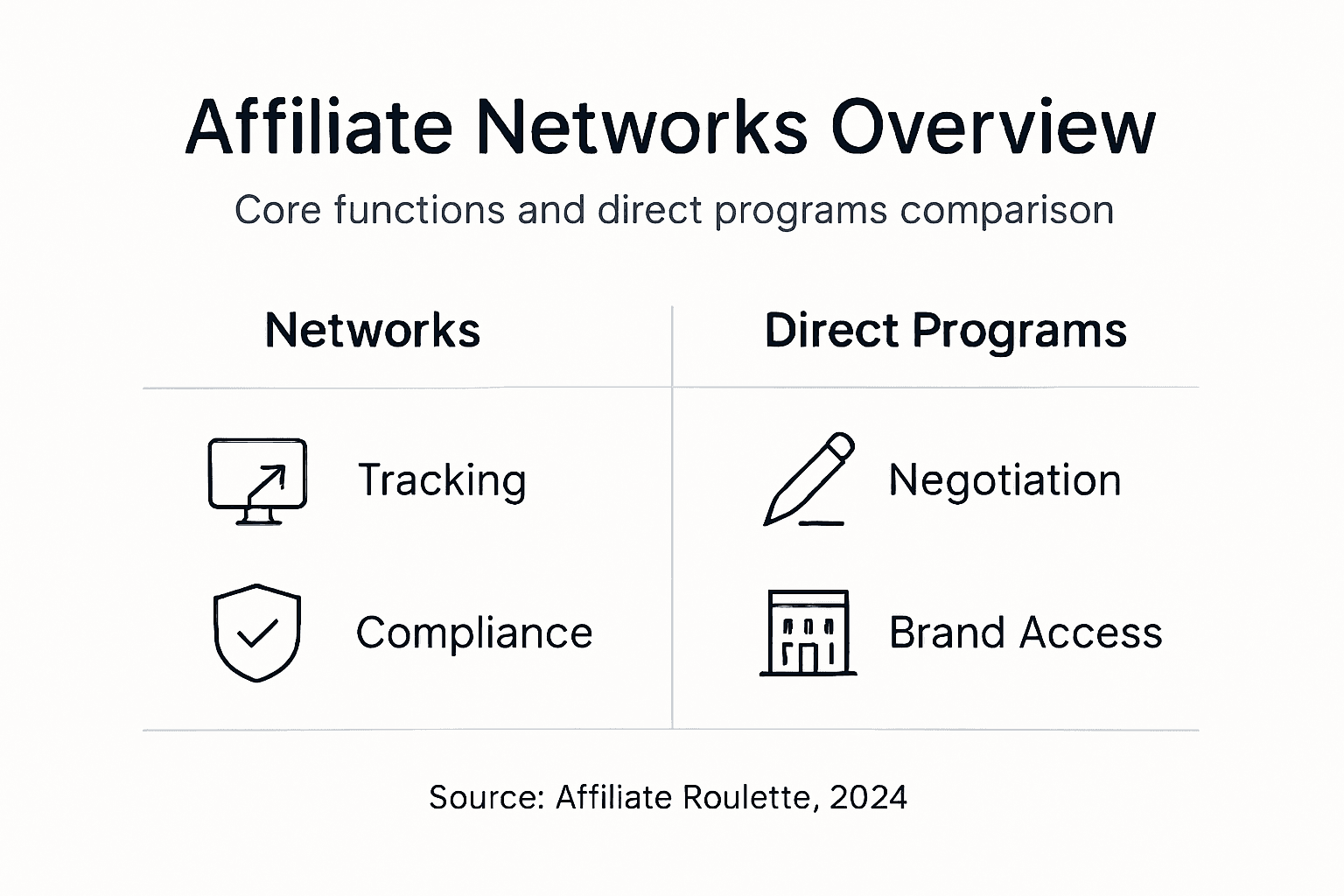
- Core Functions Of Affiliate Networks
- Common Misconceptions About Affiliate Networks
- Comparison: Affiliate Networks Vs Direct Affiliate Programs
- Enhancing Collaboration And Performance Through Affiliate Networks
- Practical Tips For Choosing And Leveraging An Affiliate Network
- Conclusion And Next Steps
- Explore Our Igaming Affiliate Resources
- Frequently Asked Questions
Key Takeaways
| Point | Details |
|---|---|
| Intermediary Role | Affiliate networks connect casino operators with affiliates, managing contracts and payments. |
| Performance Tools | Networks provide tracking dashboards, compliance enforcement, and real-time reporting capabilities. |
| Risk Reduction | Networks minimize operational overhead and financial risk for both affiliates and operators. |
| Model Differences | Networks differ from direct programs in margin structure, scalability, and administrative burden. |
| Selection Criteria | Choosing networks requires evaluating transparency, technology infrastructure, and industry reputation. |
Introduction to Affiliate Networks in iGaming
Affiliate networks function as intermediaries that connect casino operators with publishers seeking to promote gaming brands. They’ve become ubiquitous in the iGaming sector because regulatory complexity and partnership volume make direct management impractical for most players. According to industry analysis, these platforms streamline contract management, payment processing, and performance tracking for both sides of the relationship.
The prevalence of networks in iGaming stems from practical necessity. Managing hundreds of affiliate relationships individually creates administrative chaos. Networks consolidate these partnerships under unified platforms with standardized terms, centralized reporting, and automated payment systems. This infrastructure reduces friction and enables scalable growth that would otherwise demand prohibitive resources.
Understanding affiliate marketing basics helps contextualize why networks emerged as essential infrastructure. Their core services include:
- Contract negotiation and standardization across multiple partnerships
- Automated commission calculation and payment distribution
- Real-time performance tracking with granular campaign analytics
- Compliance monitoring including geo-restrictions and regulatory adherence
- Fraud detection systems protecting both operators and legitimate affiliates
- Dispute resolution mechanisms reducing legal and operational conflicts
These capabilities transform chaotic partnership ecosystems into manageable, transparent operations. Networks don’t just facilitate connections; they create trusted environments where both parties can operate confidently at scale.
Core Functions of Affiliate Networks
Commission models form the financial foundation of network operations. Revenue share arrangements pay affiliates ongoing percentages of player losses, aligning long-term incentives. CPA (cost per acquisition) models provide upfront payments for new depositing customers, offering immediate cash flow. Hybrid structures combine both approaches, balancing immediate rewards with sustained earnings.
Tracking technology ensures accurate attribution and prevents commission disputes. Pixel-based tracking embeds invisible images on affiliate sites that fire when visitors click through to operator platforms. Server-to-server tracking bypasses browser limitations, providing more reliable data for mobile traffic and privacy-focused users. Advanced networks employ fingerprinting techniques that identify users across devices without relying solely on cookies.
Compliance enforcement protects all parties from regulatory penalties. Networks implement KYC (Know Your Customer) verification protocols ensuring affiliates meet legal standards. Geo-targeting tools automatically block traffic from restricted jurisdictions, preventing inadvertent violations. Fraud prevention systems detect suspicious patterns like bot traffic, incentivized signups, or self-referrals that could compromise operator profitability.
Transparency mechanisms build trust through accessible data. Real-time dashboards display click volumes, conversion rates, commission earnings, and player lifetime values. These interfaces enable affiliates to optimize campaigns based on actual performance rather than assumptions. Operators gain visibility into traffic quality and ROI metrics that inform budget allocation decisions.
Pro Tip: Prioritize networks offering advanced tracking technologies with redundant attribution methods. Single-method tracking creates vulnerability to technical failures that cost you legitimate commissions.
Common Misconceptions About Affiliate Networks
Many believe networks exclusively benefit affiliates by simplifying access to multiple brands. Reality reveals significant operator advantages including risk mitigation, streamlined payments to dozens of partners through single channels, and access to pre-vetted traffic sources. Networks absorb fraud detection costs and legal compliance burdens that would otherwise fall entirely on casino brands.
The assumption that direct deals always yield higher profits overlooks hidden costs. Direct relationships require dedicated staff for contract management, technical integrations, payment processing, and dispute resolution. These overhead expenses often exceed the margin differential between network commissions and direct terms. Networks provide scalability value that becomes increasingly important as partnership portfolios expand.
Some perceive networks as simple plug-and-play solutions requiring minimal understanding. Effective network utilization demands comprehension of commission structures, payment terms, traffic quality requirements, and compliance obligations. Failing to grasp these nuances leads to rejected traffic, withheld payments, or terminated partnerships. Success requires active engagement with network resources and support teams.
-
Myth: Networks charge exorbitant fees that eliminate profitability for affiliates.
Reality: Most networks operate on operator-paid models where affiliates receive full advertised commissions without deductions. -
Myth: Direct programs always offer superior commission rates.
Reality: Networks negotiate bulk terms that sometimes exceed individually available direct deals, especially for smaller affiliates. -
Myth: All networks provide equivalent services and technology.
Reality: Significant variation exists in tracking accuracy, reporting granularity, payment reliability, and compliance support.
Pro Tip: Always review network contracts thoroughly before onboarding. Payment terms, minimum thresholds, and termination clauses vary dramatically and significantly impact your actual earnings timeline.
Comparison: Affiliate Networks vs Direct Affiliate Programs
| Feature | Affiliate Networks | Direct Affiliate Programs |
|---|---|---|
| Commission Rates | Standardized across partners, potentially lower margins | Negotiable, often higher for established affiliates |
| Administrative Burden | Minimal, network handles contracts and payments | High, requires individual relationship management |
| Compliance Support | Comprehensive monitoring and enforcement | Affiliate responsible for understanding requirements |
| Scalability | Easy addition of new brands through existing platform | Each new partnership requires separate negotiation |
| Payment Processing | Consolidated monthly payments from single source | Multiple payment schedules and methods to track |
| Tracking Technology | Standardized across network with proven reliability | Varies by operator, integration complexity differs |
Industry data confirms networks offer centralized payment processing and fraud controls but may deliver lower margins than optimized direct arrangements. The tradeoffs involve balancing convenience against maximum earning potential.
Key considerations when evaluating models:
- Risk tolerance: Networks absorb payment default risk that falls on affiliates in direct deals
- Scale ambitions: Managing 50+ direct relationships becomes operationally prohibitive
- Technical capability: Direct integrations require development resources many affiliates lack
- Negotiation leverage: Established affiliates command better direct terms; newcomers benefit from network standardization
New affiliates typically benefit from network infrastructure providing instant access to multiple brands without negotiation barriers. Large affiliates with proven traffic volumes often secure superior direct terms that justify additional administrative overhead. Hybrid approaches combining networks for volume with selective direct deals for premium partners optimize both convenience and earnings.
Understanding collaboration dynamics helps determine which model aligns with your operational capabilities and growth objectives. Neither approach universally surpasses the other; context determines optimal strategy.
Enhancing Collaboration and Performance Through Affiliate Networks
Centralized communication platforms eliminate the fragmented email chains and missed messages that plague direct partnerships. Networks provide unified messaging systems where affiliates can contact multiple brands through single interfaces. Operators similarly reach their entire affiliate base with promotional updates, compliance reminders, or performance feedback through streamlined channels.

Performance dashboards transform raw data into actionable insights. Real-time analytics reveal which traffic sources convert best, which brands generate highest player values, and which campaigns underperform. This visibility enables rapid optimization that would require manual data compilation in direct arrangements.
Contract and payment standardization reduces disputes that consume time and damage relationships. Networks establish clear terms accepted by all parties upfront, minimizing ambiguity about commission calculations or payment schedules. Automated systems process earnings according to predefined rules, eliminating human error and processing delays.
Collaboration benefits extend beyond operational efficiency:
- Transparency: Shared access to performance metrics builds trust between parties
- Dispute resolution: Neutral third-party mediation resolves conflicts fairly without litigation
- Knowledge sharing: Networks facilitate best practice exchange through community forums and educational resources
- Operational scaling: Adding partners requires minimal incremental effort compared to direct expansion
- Brand protection: Networks enforce quality standards protecting operator reputations from unethical affiliates
Networks function as relationship infrastructure that would cost millions to replicate independently. For most participants, this collaborative framework justifies any margin tradeoffs through reduced friction and enhanced scalability. The efficiency gains compound over time as partnership portfolios grow.
Leveraging network tools fully requires active engagement rather than passive participation. Affiliates who regularly analyze dashboards, test promotional materials, and communicate with account managers consistently outperform those treating networks as simple payment channels. Similarly, operators who provide networks with quality creatives and responsive support maximize affiliate motivation and overall performance.
Practical Tips for Choosing and Leveraging an Affiliate Network
Selecting the right network demands systematic evaluation beyond surface-level commission rates. Follow this stepwise approach:
-
Research reputation thoroughly by reading reviews from current affiliates and checking payment reliability records across industry forums.
-
Verify compliance mechanisms including geo-blocking capabilities, KYC processes, and regulatory licenses in target markets.
-
Evaluate commission structures comparing not just rates but also payment terms, minimum thresholds, and negative carryover policies.
-
Assess technology infrastructure by requesting demo access to dashboards, testing tracking accuracy, and reviewing API documentation.
-
Examine brand portfolio quality ensuring the network represents reputable operators with strong player retention rather than churn-and-burn brands.
-
Understand support availability including response times, dedicated account management, and technical assistance accessibility.
Evaluation criteria must prioritize factors affecting your actual earnings and operational efficiency. Headline commission rates mean nothing if payments arrive late or tracking loses 20% of legitimate conversions.
Payment reliability deserves special scrutiny. Research the network’s financial stability, payment history, and any past disputes involving withheld earnings. Established networks with years of consistent payments present far less risk than new entrants without proven track records.
Legal compliance mechanisms protect you from inadvertent violations. Verify that networks provide robust geo-targeting preventing traffic from restricted jurisdictions. Confirm they maintain proper licensing and stay current with evolving regulations across multiple markets. Your reputation and legal exposure depend on these safeguards.
Pro Tip: Engage network support teams during evaluation, not just after joining. Their responsiveness and expertise during the sales process accurately preview the service quality you’ll receive as a partner.
Maximizing network benefits requires strategic utilization:
- Regularly review performance data identifying top-converting brands and traffic sources
- Test promotional materials systematically rather than assuming initial choices remain optimal
- Maintain open communication with account managers who can provide insider optimization tips
- Leverage network educational resources staying current with program selection strategies and industry trends
Consider creating quality affiliate listings that showcase your traffic capabilities, potentially attracting direct offers from network brands seeking deeper partnerships. Technical excellence matters too; finding skilled developers who can implement advanced tracking and optimize conversion funnels significantly impacts earnings regardless of network choice.
Conclusion and Next Steps
Affiliate networks provide essential infrastructure enabling efficient, compliant, and scalable partnerships in the complex iGaming ecosystem. Their value extends beyond simple intermediation to encompass tracking technology, compliance enforcement, dispute resolution, and performance optimization tools that would cost prohibitive amounts to develop independently.
Choosing the right network requires evaluating reputation, technology capabilities, commission structures, and compliance support rather than focusing solely on headline rates. The optimal selection depends on your scale, technical sophistication, and risk tolerance. New affiliates typically benefit most from established networks offering comprehensive support, while experienced operators might balance network relationships with selective direct deals.
Proactive engagement with network resources transforms passive partnerships into strategic advantages. Regular dashboard analysis, systematic promotional testing, and open communication with support teams consistently separate top performers from average participants. The tools exist; success depends on utilizing them effectively.
Approaching networks strategically rather than opportunistically positions you for sustained growth in competitive iGaming markets. Understanding their functions, limitations, and optimization potential enables informed decisions that align partnership structures with business objectives.
Explore Our iGaming Affiliate Resources
Affiliate Roulette provides comprehensive resources helping affiliates and operators navigate the iGaming partnership landscape successfully. Our platform connects you with verified partners while offering expert guidance on network selection, campaign optimization, and performance maximization.

Access our beginner’s guide to casino and betting affiliation for foundational knowledge building your understanding of the industry. Explore strategies for maximizing ROI in iGaming affiliate marketing through data-driven approaches and proven techniques. Learn how networks facilitate driving casino-affiliate success through enhanced collaboration and transparency.
Pro Tip: Regularly update your strategies using Affiliate Roulette’s latest insights and industry analysis, ensuring you stay ahead of market shifts and regulatory changes affecting partnership dynamics.
Frequently Asked Questions
How do affiliate networks process payments to affiliates?
Networks consolidate earnings from multiple brands into single monthly payments, typically processed via bank transfer, e-wallets, or cryptocurrency. Most networks require minimum thresholds (often $100-$500) before issuing payments, with earnings below thresholds rolling into subsequent periods.
What fees do affiliate networks charge to affiliates?
Most reputable networks charge zero direct fees to affiliates, instead taking commissions from operators for facilitating partnerships. Affiliates receive the full advertised commission rates without deductions, making network participation cost-neutral from the publisher perspective.
How do networks ensure compliance with gambling regulations?
Networks implement automated geo-blocking preventing traffic from restricted jurisdictions, require affiliate KYC verification, monitor promotional content for regulatory compliance, and maintain licenses in relevant markets. They assume significant compliance responsibility that would otherwise fall entirely on individual affiliates.
Can affiliates join multiple networks simultaneously?
Absolutely. Most successful affiliates maintain relationships with several networks, accessing diverse brand portfolios and comparing commission structures across platforms. Multiple network participation maximizes earning opportunities and reduces dependence on any single partnership.
What happens if tracking fails and commissions are lost?
Reputable networks provide dispute resolution processes where affiliates can report tracking discrepancies with supporting evidence. Quality networks investigate claims fairly and credit legitimate lost commissions. This protection represents a key advantage over direct deals lacking neutral arbitration. Understanding affiliate marketing fundamentals helps you recognize and document tracking issues effectively.
How long do network approval processes typically take?
Network approval timelines range from 24 hours to two weeks depending on the thoroughness of their vetting process. Networks requiring detailed traffic source documentation and compliance verification take longer but generally provide more stable, reliable partnerships than those approving affiliates instantly without scrutiny.
Recommended
Comments
You must be logged in to leave a review.