What is affiliate fraud and how to prevent it in iGaming

Affiliate fraud costs the iGaming industry billions annually, yet many operators and affiliates underestimate its complexity and reach. Comprehensive research shows fraudulent traffic leads to substantial financial losses and skews performance metrics across the sector. This guide explains what affiliate fraud is, how sophisticated fraudsters operate undetected, and practical strategies you can implement to protect your partnerships and maximize ROI. You’ll discover detection methods, compliance implications, and technologies that reduce fraud risk while maintaining trust with legitimate affiliates.
Table of Contents
- Key takeaways
- Understanding affiliate fraud in iGaming
- Prevalence, financial impact, and detection challenges
- Effective strategies and technologies to mitigate affiliate fraud
- Navigating legal and compliance implications of affiliate fraud
- Learn how Affiliate Roulette helps fight fraud and build trust
- FAQ
Key Takeaways
| Point | Details |
|---|---|
| Common fraud tactics | Fraudsters use bot traffic, cookie stuffing, fake registrations, bonus abuse networks, and click injection to inflate metrics and claim commissions they did not earn. |
| Scale and impact | Global losses from affiliate marketing fraud reach 1.6 billion dollars annually, with iGaming fraud rates ranging from 14.3 percent to 30 percent depending on market maturity. |
| Detection challenges | Fraud remains hard to detect because sophisticated fraudsters imitate real user behavior and continuously adapt their methods. |
| Layered defenses | Operators should deploy layered defenses and specialized anti fraud tools to reduce risk while maintaining trust with legitimate affiliates. |
Understanding affiliate fraud in iGaming
Affiliate fraud represents one of the most persistent threats to online casino operations and partnership integrity. It encompasses any deceptive practice where affiliates manipulate traffic, conversions, or player data to claim commissions they haven’t legitimately earned. Unlike organic marketing efforts that drive real players to your platform, fraudulent methods create artificial activity that inflates reported metrics while delivering zero genuine value.
The iGaming sector faces unique vulnerability because of its cost-per-acquisition models and high commission structures. When affiliates earn substantial payouts for each new player registration or first deposit, the financial incentive to cheat becomes enormous. Fraudsters exploit this by deploying sophisticated tactics that mimic legitimate user behavior while generating fake conversions at scale.
Common fraud methods include:
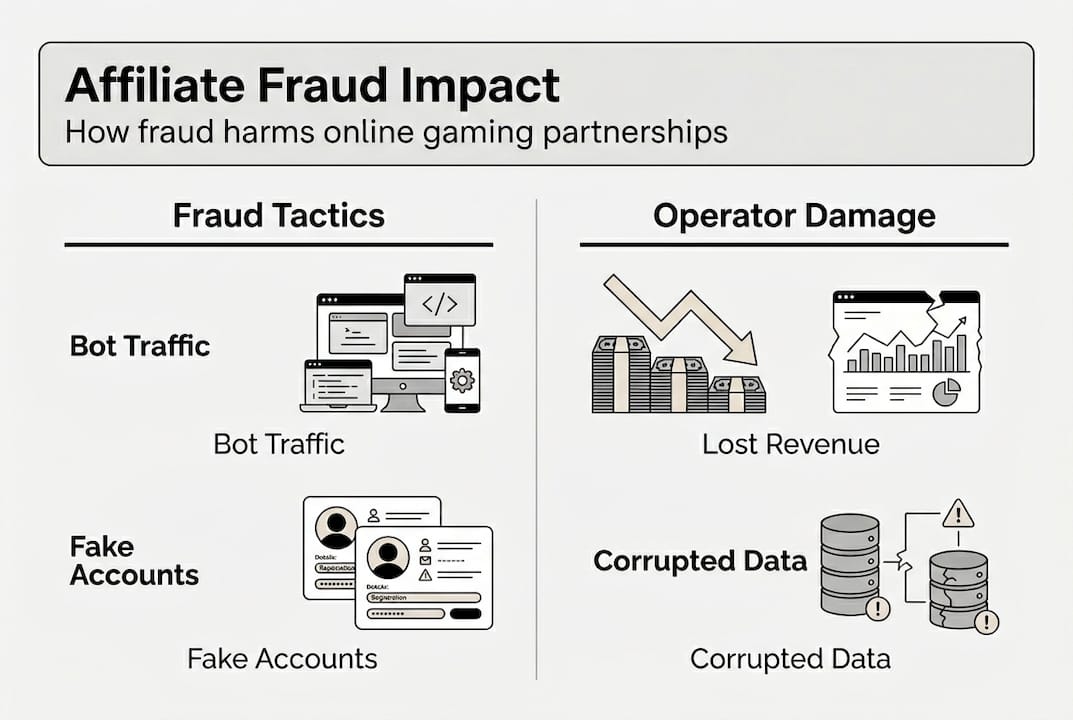
- Bot traffic generation: Automated scripts create fake clicks and registrations that appear human but never convert to real players
- Cookie stuffing: Fraudsters place tracking cookies on users’ devices without consent, claiming credit for conversions they didn’t influence
- Fake registrations: Using stolen or fabricated identity data to create accounts that pass initial verification but never engage authentically
- Bonus abuse networks: Coordinated groups exploit welcome bonuses across multiple accounts, draining promotional budgets without genuine play
- Click injection: Mobile malware intercepts legitimate app installs and redirects attribution to fraudulent affiliates
These tactics harm your bottom line by inflating commission payouts while corrupting the performance data you rely on for strategic decisions. When 30% of your reported conversions come from fraudulent sources, you’re essentially paying for ghost players while misallocating marketing budgets away from channels that actually work. Legitimate affiliates suffer too, as fraudsters crowd them out and devalue the entire partnership ecosystem.
The iGaming industry’s global reach and high transaction volumes create perfect conditions for fraud to flourish undetected. Operators processing thousands of registrations daily struggle to distinguish genuine patterns from manufactured ones, especially when fraudsters continuously adapt their methods. Fighting fraud requires understanding these specific tactics and implementing targeted countermeasures that address each vulnerability point in your affiliate program.
Prevalence, financial impact, and detection challenges
The scale of affiliate fraud in iGaming exceeds what most operators initially realize. Research indicates global losses from affiliate marketing fraud reach $1.6 billion annually, with iGaming affiliate fraud rates ranging between 14.3% and 30% depending on market maturity and regulatory oversight. Regulated markets with strict licensing requirements typically see lower fraud rates around 14%, while less regulated jurisdictions experience rates exceeding 25% as fraudsters exploit weaker verification systems.
Financial consequences extend beyond direct commission losses. Operators waste marketing budgets on fake traffic that never converts to revenue, skewing lifetime value calculations and ROI metrics across all channels. When your analytics show strong affiliate performance but actual player deposits remain flat, fraud is likely corrupting your data. This misallocation means you might cut spending on legitimate channels while increasing budgets for fraudulent ones, compounding losses over time.
| Market Type | Fraud Rate | Avg Loss per Operator | Primary Fraud Methods |
|---|---|---|---|
| Regulated markets | 14-18% | $180K annually | Cookie stuffing, bonus abuse |
| Emerging markets | 22-30% | $340K annually | Fake registrations, bot traffic |
| Unregulated markets | 25-35% | $520K annually | All methods, VPN masking |
Detection complexity has increased dramatically as fraudsters adopt sophisticated technologies. AI and machine learning tools face limitations including false positives that flag legitimate affiliates and false negatives that miss clean-looking fraudulent activity. Modern fraud operations use real device emulators that perfectly mimic authentic user behavior, passing standard bot detection systems without triggering alerts.
Key detection challenges include:
- VPN and proxy masking: Fraudsters hide true geographic origins, making geo-compliance verification nearly impossible through IP analysis alone
- AI-generated content: Fake review sites and promotional materials appear legitimate, building trust before directing traffic to claim commissions
- Timing manipulation: Sophisticated cookie stuffing occurs milliseconds before legitimate conversions, making attribution analysis extremely difficult
- Clean fraud patterns: High-quality fake registrations use valid stolen identities that pass KYC checks initially but never engage authentically
The false positive problem creates additional operational burden. When detection systems flag 20% of legitimate affiliates as suspicious, you waste resources investigating clean partners while actual fraudsters slip through. This balance between sensitivity and specificity requires constant calibration, as overly aggressive filtering damages relationships with your best performers while lenient settings allow fraud to proliferate.
Geographic variations in fraud prevalence reflect regulatory maturity and enforcement capability. Markets with established gaming commissions and mandatory compliance audits see lower rates because fraudsters face higher detection risk and legal consequences. Conversely, jurisdictions with minimal oversight become fraud hotspots where bad actors operate with impunity. Understanding these patterns helps operators allocate fraud prevention resources strategically based on market-specific risk profiles.

Effective strategies and technologies to mitigate affiliate fraud
Combating affiliate fraud requires layered defenses that combine technological solutions with operational best practices. No single tool eliminates fraud completely, but predictive multi-layer systems significantly reduce exposure when properly implemented and maintained. The key lies in creating multiple verification checkpoints that make fraud economically unviable for bad actors while minimizing friction for legitimate partners.
Successful fraud mitigation follows these prioritized steps:
- Implement real-time traffic analysis: Monitor behavioral patterns including mouse movements, scroll depth, and engagement timing to distinguish human users from bots
- Deploy predictive analytics: Use historical data to establish baseline patterns for legitimate affiliate performance, flagging statistical anomalies automatically
- Integrate specialized platforms: Anti-fraud tools like PartnerMatrix and Fraudlogix provide real-time detection algorithms trained specifically on iGaming fraud patterns
- Prioritize lifetime value metrics: Shift commission structures toward revenue share models that reward long-term player value rather than initial conversions
- Establish verification protocols: Require affiliates to complete identity verification and demonstrate legitimate traffic sources before approval
- Conduct regular manual audits: Automated systems miss sophisticated fraud, so periodic human review of top-performing affiliates catches anomalies algorithms overlook
- Calibrate detection thresholds: Continuously adjust sensitivity based on false positive rates and emerging fraud tactics to maintain optimal performance
Technology plays a crucial role but requires strategic implementation. Microbidding systems analyze traffic quality at granular levels, adjusting commission rates dynamically based on conversion probability and fraud risk scores. Zone-based analysis segments traffic by geography, device type, and referral source to identify suspicious patterns that aggregate data might mask. These approaches work best when combined with compliance team involvement, as AML specialists bring expertise in recognizing money laundering patterns that overlap with affiliate fraud.
Pro Tip: Schedule quarterly calibration sessions where you review false positive rates, analyze missed fraud cases, and adjust detection parameters based on real-world feedback. This iterative process keeps your systems effective as fraud tactics evolve while maintaining trust with legitimate affiliates who appreciate transparent, fair evaluation criteria.
Platform selection matters significantly for fraud prevention effectiveness. Specialized anti-fraud solutions designed for iGaming understand industry-specific fraud vectors better than generic tools, offering features like bonus abuse detection and multi-account identification that standard analytics platforms lack. When evaluating options, prioritize vendors with proven iGaming experience, transparent methodology, and integration capabilities with your existing affiliate tracking systems.
Operational practices complement technological defenses. Establishing clear affiliate agreements that define prohibited practices and outline consequences creates legal recourse when fraud occurs. Regular communication with your affiliate network builds relationships that encourage self-policing, as legitimate partners have strong incentives to report suspicious activity that damages the ecosystem’s reputation. Industry best practices emphasize this collaborative approach over purely adversarial fraud detection.
The limitation reality remains important to acknowledge. Even sophisticated systems achieve 85-90% fraud detection rates at best, meaning some fraudulent activity will slip through. Budget for this reality by building fraud loss projections into your financial models and maintaining reserves to cover unexpected spikes. Innovation in detection technologies continues advancing, but fraudsters adapt quickly, creating an ongoing arms race that requires sustained investment and attention.
Navigating legal and compliance implications of affiliate fraud
Affiliate fraud creates significant regulatory exposure beyond direct financial losses. Gaming regulators increasingly scrutinize operator relationships with affiliates, holding licensees accountable for their partners’ activities even when operators themselves aren’t directly complicit. Fraud connections to money laundering and geo-compliance breaches impose regulatory penalties that can include license suspension, substantial fines, and permanent market exclusion in severe cases.
Anti-money laundering obligations represent the most serious compliance risk. When fraudulent affiliates generate fake registrations using stolen identities, they create vehicles for layering illicit funds through your platform. Regulators view inadequate affiliate vetting as a failure in your AML controls, potentially triggering enforcement actions even if you profited minimally from the fraudulent activity. This liability extends to your payment processors and banking relationships, as financial institutions face their own regulatory scrutiny for facilitating suspicious transactions.
Geographic compliance violations occur when fraud masks player locations through VPN use. If your license restricts operations to specific jurisdictions, fraudulent affiliates directing traffic from prohibited regions puts you in breach regardless of your intent. Regulators rarely accept ignorance as a defense, expecting operators to implement robust geo-verification that goes beyond simple IP checking. The challenge intensifies as VPN technology becomes more sophisticated, requiring device fingerprinting and behavioral analysis to detect location spoofing reliably.
“Operators face average regulatory fines of $2.3 million for compliance breaches linked to affiliate fraud, with repeat violations resulting in license revocation in 40% of cases across major regulated markets.”
Reputational damage compounds legal risks. When media reports link your brand to fraudulent affiliate schemes, player trust erodes rapidly even if you were a victim rather than a perpetrator. This perception problem affects player acquisition costs, banking relationships, and partnership opportunities with legitimate affiliates who avoid association with tainted brands. Recovery requires years of demonstrated compliance improvement and transparent communication about remediation efforts.
Compliance best practices for affiliate fraud prevention include:
- Integrate AML teams early: Involve anti-money laundering specialists in affiliate approval processes to identify high-risk patterns before partnerships begin
- Implement comprehensive KYC: Require detailed identity verification for all affiliates including beneficial ownership disclosure for corporate entities
- Maintain detailed documentation: Keep thorough records of affiliate vetting procedures, performance monitoring, and fraud investigation outcomes for regulatory review
- Establish clear policies: Document prohibited practices, detection methodologies, and enforcement procedures to demonstrate systematic compliance efforts
- Conduct regular compliance audits: Schedule independent reviews of affiliate programs to identify gaps in controls before regulators discover them
The regulatory landscape continues evolving with stricter affiliate accountability requirements. Recent guidance from major gaming jurisdictions emphasizes operator responsibility for partner activities, shifting from caveat emptor approaches toward proactive monitoring obligations. Understanding these regulatory impacts helps you prioritize compliance investments strategically, focusing resources on areas where regulatory risk concentration is highest.
Legal recourse against fraudulent affiliates provides some protection but rarely recovers losses completely. Jurisdiction challenges complicate enforcement when fraudsters operate from countries with weak legal cooperation, making contract provisions largely unenforceable. This reality makes prevention far more valuable than remediation, as recovering funds through litigation typically costs more than the fraud itself while consuming management attention over extended periods.
Learn how Affiliate Roulette helps fight fraud and build trust
Protecting your iGaming partnerships from fraud requires specialized tools designed specifically for industry challenges. Affiliate Roulette provides comprehensive solutions that help operators identify trustworthy partners while giving legitimate affiliates platforms to demonstrate their value transparently. The verification systems and community ratings create accountability that makes fraud economically unviable while rewarding genuine performance.

Operators using Affiliate Roulette benefit from reduced fraud exposure through verified affiliate listings, performance tracking, and fraud reporting mechanisms that surface suspicious activity quickly. The platform’s transparency tools help you evaluate potential partners based on community feedback and documented track records rather than relying solely on self-reported metrics. This collaborative approach builds trust throughout the ecosystem while making it significantly harder for fraudulent actors to operate undetected. Partnerships focused on fraud reduction deliver better ROI by ensuring your marketing spend reaches genuine players through legitimate channels.
Legitimate affiliates gain equally valuable benefits through enhanced credibility and fair commission environments. The verification process distinguishes you from fraudulent competitors, making operators more willing to offer competitive rates and long-term partnerships. Platforms like KeyAffiliates demonstrate how transparency and verification create value for both sides of the partnership equation. Transforming iGaming partnerships through these mechanisms represents the industry’s evolution toward sustainable, fraud-resistant affiliate marketing that benefits all legitimate participants.
FAQ
What is affiliate fraud?
Affiliate fraud refers to deceptive practices where affiliates manipulate traffic, conversions, or player data to claim commissions without generating genuine referrals. Common methods include bot traffic, cookie stuffing, fake registrations, and bonus abuse schemes. These tactics inflate reported metrics while delivering zero real value to operators, resulting in wasted marketing budgets and corrupted performance data that undermines strategic decision-making.
How do iGaming affiliates commit fraud without getting caught?
Fraudsters use sophisticated technologies including real device emulators that mimic authentic user behavior, AI-generated content that appears legitimate, and VPNs that mask geographic origins. They employ stolen identities that pass initial KYC verification and time their activities to blend with legitimate traffic patterns. These methods complicate detection by traditional audits, requiring advanced analytics and specialized anti-fraud platforms to identify suspicious patterns that standard monitoring tools miss.
What are the consequences of affiliate fraud for operators?
Operators suffer direct financial losses through inflated commission payments and misallocated marketing budgets that fund fake traffic instead of genuine player acquisition channels. Fraud jeopardizes regulatory compliance by creating AML risks and geo-blocking violations that can result in license suspension and substantial fines. Brand reputation damage occurs when media links your platform to fraudulent schemes, increasing player acquisition costs and damaging relationships with legitimate affiliates and banking partners.
How can operators and affiliates reduce affiliate fraud risk?
Implement layered detection systems combining predictive analytics, real-time behavioral monitoring, and specialized anti-fraud platforms designed for iGaming fraud patterns. Prioritize lifetime value metrics over initial conversion commissions to align incentives with genuine player quality. Integrate compliance teams in affiliate approval processes and conduct regular manual audits to catch sophisticated fraud that automated systems miss. Calibrate detection thresholds quarterly based on false positive rates and emerging tactics to maintain optimal performance while preserving relationships with legitimate partners.
Recommended
Comments
You must be logged in to leave a review.