What is iGaming compliance? A 2026 expert guide

Online casino operator ProgressPlay Limited paid a £1 million fine in 2025 for anti-money laundering and social responsibility failures. This isn’t an isolated incident. iGaming compliance demands rigorous systems, constant vigilance, and deep understanding of regulatory expectations across multiple domains. This guide breaks down the critical components of compliance in 2026, from AML protocols to affiliate marketing standards, showing you how to build robust frameworks that protect your operations and reputation while meeting evolving regulatory demands.
Table of Contents
- Understanding iGaming Compliance: Scope And Significance
- Critical Components Of Compliance: AML, Responsible Gambling, And Security
- Player Account Management Systems And Their Role In Compliance
- Navigating Affiliate Marketing Compliance In iGaming
- Explore Tools And Insights To Master iGaming Compliance
Key takeaways
| Point | Details |
|---|---|
| Compliance scope | iGaming compliance encompasses AML, responsible gambling, data security, and licensing requirements across jurisdictions. |
| Financial penalties | Major operators face fines exceeding £1 million for AML and social responsibility failures, highlighting enforcement intensity. |
| Technology role | Player Account Management systems enable scalable compliance through automated monitoring, limits enforcement, and behavioral tracking. |
| Affiliate obligations | Marketing partners must adhere to truthful advertising, jurisdictional restrictions, and data privacy regulations to avoid penalties. |
| Continuous adaptation | Regulatory standards evolve constantly, requiring ongoing system updates and policy refinements to maintain compliance. |
Understanding iGaming compliance: scope and significance
iGaming compliance represents the comprehensive framework of policies, systems, and practices operators and affiliates must implement to meet legal and regulatory requirements. This framework spans multiple critical areas: anti-money laundering protocols, data protection measures, licensing obligations, and social responsibility initiatives. Each component carries specific technical requirements and operational standards that regulators actively monitor and enforce through audits, investigations, and penalty assessments.
The significance of robust compliance infrastructure extends beyond avoiding fines. Operators who fail to implement adequate systems risk license revocation, reputational damage, and loss of payment processing partnerships. Regulatory bodies increasingly rely on Independent Security Firms for gaming security assessments complementing traditional lab certifications, raising the bar for technical controls and audit readiness. These assessments evaluate everything from random number generator integrity to customer data encryption standards.
Compliance affects multiple stakeholders across the iGaming ecosystem. Casino operators bear primary responsibility for implementing controls and maintaining audit trails. Affiliates promoting gaming products must ensure their marketing practices align with advertising standards and jurisdictional restrictions. Payment processors need verification systems that detect suspicious transaction patterns. Software providers must build compliance features directly into their platforms. Understanding how regulatory waters of iGaming affect each role helps build coordinated compliance strategies.
Core compliance areas include:
- Licensing and regulatory authorization across operating jurisdictions
- Anti-money laundering controls including transaction monitoring and source of funds verification
- Responsible gambling measures such as deposit limits, self-exclusion tools, and harm indicator tracking
- Information security controls protecting customer data and financial transactions
- Fair gaming standards ensuring random outcomes and transparent payout percentages
- Advertising compliance covering truthfulness, age restrictions, and vulnerability protections
Pro Tip: Build compliance documentation as you implement controls rather than retroactively. Regulators scrutinize audit trails and decision records during investigations, making contemporaneous documentation your strongest defense during enforcement reviews.
Critical components of compliance: AML, responsible gambling, and security
Anti-money laundering requirements form the foundation of financial compliance in iGaming operations. Operators must conduct thorough risk assessments identifying high-risk customer segments, transaction patterns, and geographic exposures. These assessments inform monitoring thresholds and trigger enhanced due diligence procedures for suspicious activity. Transaction scrutiny involves automated systems flagging unusual deposit patterns, rapid turnover of funds, and inconsistent betting behavior that suggests layering or integration of illicit proceeds.

Source of funds verification represents a critical AML control that many operators implement inadequately. When customers deposit significant amounts, operators must obtain documentation proving the legitimate origin of those funds. Pay stubs, bank statements, tax returns, and business ownership records provide evidence of lawful income sources. ProgressPlay Limited was fined £1 million partly for insufficient risk assessments and poor customer monitoring, demonstrating how verification gaps lead to enforcement action.
Social responsibility expectations require operators to identify harm indicators and intervene before customers experience severe gambling-related damage. Customer behavior monitoring tracks metrics like session duration, deposit frequency, loss chasing patterns, and failed payment attempts. These indicators trigger interventions ranging from automated reality checks to account restrictions and direct customer contact. Videoslots Limited paid £650,000 for failures in AML systems and social responsibility monitoring, illustrating how both compliance pillars receive equal enforcement scrutiny.
Cybersecurity and IT controls protect data integrity while preventing fraud and unauthorized access. Encryption standards, access controls, incident response procedures, and vulnerability management programs form the technical foundation of information security. Operators must implement multi-factor authentication, secure API integrations, and regular penetration testing to identify weaknesses before attackers exploit them. These controls also support AML compliance by ensuring transaction records remain tamper-proof and audit trails stay complete.
Common AML and social responsibility failures cited by regulators include:
- Inadequate customer risk assessments failing to identify high-risk profiles requiring enhanced monitoring
- Delayed or absent source of funds verification allowing suspicious deposits to proceed unchecked
- Ineffective transaction monitoring systems missing obvious layering patterns and structuring attempts
- Poor harm indicator tracking failing to detect customers exhibiting clear problem gambling behaviors
- Insufficient staff training leaving frontline teams unable to recognize red flags or escalate concerns appropriately
“Strong consumer protections and robust anti-money laundering controls are not optional extras but fundamental requirements for any operator seeking to maintain their license and reputation in this industry.”
Automated AML systems must achieve specific performance benchmarks to satisfy regulatory expectations. False positive rates should remain below 10% to avoid overwhelming compliance teams with irrelevant alerts. Detection rates for known typologies must exceed 95% to catch sophisticated laundering schemes. System response times for flagging suspicious activity should trigger within 24 hours of transaction completion. Understanding impacts of regulation breaches in iGaming helps operators prioritize system investments and allocate compliance resources effectively. Building robust frameworks for promoting responsible gambling requires both technology and organizational commitment to player protection.
Player Account Management systems and their role in compliance
Player Account Management platforms serve as the operational backbone for compliance implementation and enforcement across iGaming operations. These systems manage comprehensive player profiles containing identity verification status, deposit and withdrawal history, betting patterns, session durations, and applied limits. PAM platforms centralize data from multiple sources including payment processors, game providers, and customer service interactions, creating unified views that enable effective monitoring and intervention.
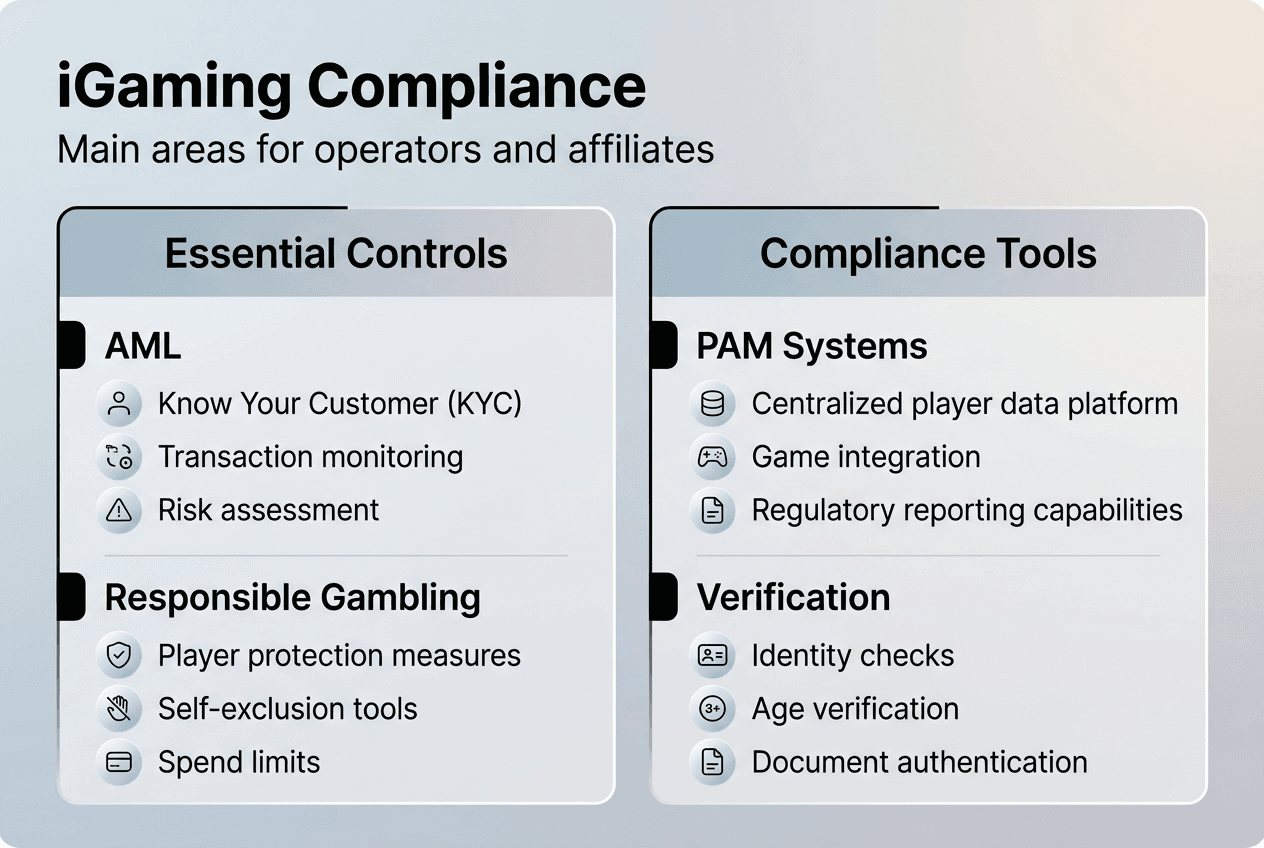
PAM systems contribute directly to regulatory compliance through several mechanisms. They track deposits against predetermined thresholds, automatically triggering source of funds requests when customers exceed limits. They enforce responsible gambling controls by applying deposit limits, loss limits, and session time restrictions that customers set or regulators mandate. They monitor risky behavior patterns, flagging accounts exhibiting harm indicators for compliance team review. They maintain complete audit trails documenting every transaction, limit change, and intervention attempt, providing evidence of compliance during regulatory examinations.
Modular PAM architecture delivers significant advantages for operators navigating complex compliance landscapes. TRUEiGTECH’s modular PAM integration allows scalability, customization, and locality with no performance bottlenecks. Operators can activate compliance modules specific to their licensed jurisdictions without carrying unnecessary functionality. They can integrate new payment methods or game providers without system-wide disruptions. They can scale processing capacity during peak periods without degrading monitoring effectiveness or audit trail completeness.
PAM features critical for compliance and operational efficiency include:
- Real-time transaction monitoring with configurable rules for AML and fraud detection
- Automated limit enforcement preventing customers from exceeding deposit, loss, or session restrictions
- Comprehensive reporting dashboards providing compliance teams with actionable insights and exception alerts
- Identity verification workflows integrating with third-party data providers for KYC checks
- Self-exclusion management coordinating restrictions across multiple brands and platforms
- Audit trail generation capturing every account action with timestamps and user attribution
- API connectivity enabling seamless integration with payment processors, game providers, and regulatory reporting systems
Pro Tip: Choose PAM solutions designed specifically for your target regulatory jurisdictions rather than generic platforms requiring extensive customization. Purpose-built systems include compliance features matching local requirements and receive updates automatically when regulations change, reducing your ongoing maintenance burden and regulatory risk.
Effective PAM implementation requires careful planning around data migration, staff training, and testing protocols. Operators must map existing customer data to new system fields, ensuring no compliance-critical information gets lost during transition. Compliance teams need thorough training on new monitoring tools and reporting interfaces to maximize system value. Comprehensive testing validates that limit enforcement, monitoring rules, and audit logging function correctly before going live. Strong PAM foundations enable operators to scale confidently while maintaining compliance standards across growing customer bases and expanding market footprints. Understanding iGaming networks for affiliate success helps operators build comprehensive partnership strategies supported by robust technical infrastructure.
Navigating affiliate marketing compliance in iGaming
Affiliate marketing compliance in iGaming carries distinct legal and regulatory requirements that marketing partners must understand and implement rigorously. Affiliates promoting casino products, sports betting platforms, or poker rooms operate under the same fundamental advertising standards as the operators they represent. Regulators hold both parties accountable for misleading claims, underage targeting, and violations of jurisdictional restrictions. This shared liability makes compliance knowledge essential for affiliates seeking sustainable, penalty-free operations.
Truthful advertising forms the cornerstone of affiliate compliance obligations. Marketing materials must accurately represent bonus terms, wagering requirements, and game odds without exaggeration or omission of material conditions. Claims about winning potential require clear disclaimers about house edge and probability. Testimonials must come from genuine customers rather than fabricated endorsements. Visual representations of gameplay should match actual product experiences. Regulators scrutinize affiliate content as closely as operator advertising, imposing fines when promotions mislead consumers or violate advertising codes.
Jurisdictional restrictions create complex compliance challenges for affiliates operating across multiple markets. Many regions prohibit iGaming advertising entirely, while others allow promotions only for locally licensed operators. Affiliates must implement geo-targeting controls preventing restricted audiences from accessing promotional content. They need verification systems confirming that promoted operators hold valid licenses in markets where affiliates drive traffic. They must monitor regulatory changes across operating territories, updating content and targeting parameters when rules shift.
Data protection and privacy considerations affect how affiliates collect, store, and utilize customer information. Cookie consent mechanisms must meet GDPR standards in European markets. Customer data collected through affiliate sites requires secure storage and limited retention periods. Sharing player information with operators needs explicit consent and contractual data processing agreements. Affiliates handling sensitive information face the same breach notification requirements and security standards as operators themselves.
Best practices for maintaining affiliate compliance include:
- Conducting regular audits of promotional content ensuring accuracy of bonus terms and game descriptions
- Implementing robust age verification and geo-blocking preventing underage or restricted market access
- Maintaining detailed records of operator license verification and jurisdictional authorization checks
- Establishing clear contractual terms with operators defining compliance responsibilities and liability allocation
- Monitoring regulatory updates across operating markets and adjusting campaigns promptly when rules change
- Training content creators and marketing teams on advertising standards and prohibited practices
Links between affiliate compliance and operator obligations for responsible gambling strategies create shared accountability frameworks. Affiliates must include responsible gambling messaging in promotional materials, provide links to support resources, and avoid targeting vulnerable populations. Operators must monitor affiliate partner compliance through regular content reviews and enforce standards through partnership agreements. This collaborative approach protects both parties from regulatory action while supporting broader harm minimization objectives. Understanding iGaming affiliate marketing compliance requirements helps marketing partners build sustainable businesses aligned with regulatory expectations and industry best practices.
Explore tools and insights to master iGaming compliance
Affiliate Roulette provides comprehensive resources helping compliance professionals and marketing partners navigate the complex iGaming regulatory landscape with confidence. Our platform connects verified affiliates with reputable operators, ensuring partnership opportunities align with compliance standards and jurisdictional requirements. Access expert guides covering everything from AML implementation to responsible gambling frameworks, giving you actionable insights for building robust compliance programs.
Discover how strategic affiliate partnerships supported by proper compliance infrastructure drive sustainable growth in competitive iGaming markets. Our online gambling affiliate marketing guide breaks down effective promotional strategies while maintaining regulatory alignment. Learn how iGaming networks for affiliate partnerships facilitate connections between compliant operators and quality traffic sources. Explore techniques for diversifying traffic sources to reduce regulatory concentration risk while improving overall marketing ROI and campaign resilience.
What is iGaming compliance?
What are the key areas covered under iGaming compliance?
iGaming compliance encompasses anti-money laundering controls, responsible gambling measures, data protection standards, licensing requirements, and advertising regulations. Each area requires specific technical implementations, documented policies, and ongoing monitoring to satisfy regulatory expectations and avoid enforcement action.
How do AML failures typically occur in iGaming operations?
AML failures most commonly result from inadequate customer risk assessments, delayed source of funds verification, ineffective transaction monitoring systems, and insufficient staff training. Operators who rely on manual processes or outdated technology struggle to detect sophisticated laundering schemes, leading to regulatory penalties and license restrictions.
What role does Player Account Management software play in compliance?
PAM systems centralize player data, automate limit enforcement, monitor behavioral patterns, and maintain comprehensive audit trails supporting regulatory compliance. These platforms enable scalable compliance by processing large transaction volumes while flagging suspicious activity and enforcing responsible gambling controls in real time.
How can affiliates ensure they comply with iGaming marketing regulations?
Affiliates maintain compliance by conducting content audits for accuracy, implementing age verification and geo-blocking, verifying operator licenses, establishing clear contractual terms, and monitoring regulatory changes across operating markets. Regular training and documented review processes help prevent violations and demonstrate compliance commitment during regulatory examinations.
What are the consequences of non-compliance in iGaming?
Non-compliance consequences include substantial financial penalties often exceeding £1 million, license suspension or revocation, loss of payment processing partnerships, reputational damage affecting customer acquisition, and potential criminal prosecution for severe violations. These outcomes can permanently damage or end iGaming operations, making compliance investment essential for business sustainability.
Why do regulators focus so heavily on social responsibility in iGaming?
Regulators prioritize social responsibility because gambling products carry inherent harm potential requiring proactive protection measures. Operators must identify vulnerable customers early and intervene before severe damage occurs, balancing commercial objectives with consumer protection obligations that maintain industry legitimacy and public trust.
Recommended
Comments
You must be logged in to leave a review.